What Is a Good Rangefinder for Golf? Features to Check
A good golf rangefinder gives you a clear distance to the target you mean to measure. Look for simple aiming, useful flag confirmation, a slope mode you can turn off when needed, and handling that fits your round.
On this page (7 sections)
- What is a good rangefinder for golf to look for?
- How does flag confirmation help you get the right target?
- Is a slope switch useful for golf?
- Does more magnification make a rangefinder better?
- Which rangefinder features fit different golfers?
- What should you check before choosing a golf rangefinder?
- Which features matter most for your round?
A good rangefinder for golf gives you a clear distance to the target you intend to hit. Look for manageable aiming, confirmation when it locks onto the flag, slope controls that suit your rounds and a shape you can carry comfortably.
Your best fit depends on how you play. A cart rider may value a magnetic mount, while a golfer who has trouble holding a target steady may prefer stabilization.
For a quick overview of laser, GPS and hybrid options, see golf rangefinders explained. This guide focuses on the features that matter when choosing a laser model.
What is a good rangefinder for golf to look for?
A good golf rangefinder combines easy target selection, a readable view and controls you understand. Start with flag confirmation and slope mode, then consider magnification, stabilization, carry options and power.
| Feature | What it helps with | What to check |
|---|---|---|
| Flag confirmation | Helps distinguish a flag from background objects | Look for vibration, a visual signal or both |
| Slope adjustment | Shows a distance adjusted for elevation | Check how to switch it off for competition |
| Magnification | Makes distant targets appear larger in the view | Compare the stated magnification and ease of aiming |
| Stabilization | Reduces movement in the view when aiming | Consider it if holding the target steady is difficult |
| Carry or cart mount | Keeps the unit accessible during a round | Match the mount or case to how you play |
| Power and weather resistance | Affects charging, battery changes and care | Check the power type and the maker's water-resistance details |
No single feature makes a rangefinder right for every golfer. A more useful choice matches the features to your routine and gives you controls you can check before each reading.
How does flag confirmation help you get the right target?
Flag confirmation helps show that the rangefinder has locked onto the flagstick, rather than a tree or other object behind it. It can be useful when the background is busy or the pin looks small through the viewfinder.
Models use different signals. The Callaway 300 Pro has Pin Acquisition Technology and a short vibration burst, while the Bushnell Tour V6 Shift uses a flashing red visual ring and vibration.
REDTIGER describes flag locking with vibration, and Nikon describes a visual indicator and vibration.
Confirmation does not decide which target you meant to measure. Aim at the flag, watch for the signal and make sure the result fits the shot you're planning.
For more on the feature, read what pin lock does on a golf rangefinder. If you want help choosing a model with a simple view and controls, see our easy-to-use golf rangefinders guide.
Is a slope switch useful for golf?
A slope mode can show a distance adjusted for uphill or downhill elevation. This can help you account for a change in height when choosing a club.
Competition rules can restrict distance-measuring devices or slope features, so check the rules for your event. Some models have a separate control or mode for turning slope off.
The Callaway and Bushnell examples below have external slope switches, while Nikon offers an Actual Distance Mode.
Confirm the mode before you take a reading. If slope is off, the device reports actual distance rather than a slope-adjusted number; if it is on, use the adjusted distance only where permitted.
Does more magnification make a rangefinder better?
Higher magnification can make a distant target appear larger, but it doesn't automatically make aiming easier. The models here range from 6x to 7x, and all use a view you must hold on the target to take a reading.
Steadiness matters too. Nikon describes image stabilization that minimizes hand movement in the view and laser, a feature to consider if the flag is hard for you to hold in sight.
Try to weigh magnification alongside target confirmation and handling. For a closer look at reading precision and factors that affect measurements, see how accurate golf rangefinders are.
Which rangefinder features fit different golfers?
Choose features around how you carry the device and what makes aiming easier for you. These four models illustrate different combinations of slope controls, target confirmation, mounts and stabilization.
Callaway 300 Pro: external slope switch and cart magnet
The Callaway 300 Pro combines a visible slope control with flag confirmation and a built-in cart magnet. It measures in yards or meters and has 6x magnification.
Callaway states a 5–1,000-yard range and accuracy within one yard. Its Pin Acquisition Technology is described as locking onto the pin up to 300 yards away, with a short vibration burst to confirm the distance.
Consider it if you want a physical slope switch and a way to attach the unit to a cart frame. Its hard case, lens cloth and quick-start guide are included.
REDTIGER Slope Rangefinder: rechargeable power and 7x view
The REDTIGER Slope Rangefinder combines USB-C charging, 7x magnification and a slope switch. It also has a magnetic strip for metal surfaces and a magnetic belt clip for carrying.
REDTIGER describes six measurement modes, including slope compensation, flag locking, horizontal and height ranging, speed measurement and continuous scan. It states a 5–1,200-yard range and an accuracy of 0.5 yards.
Consider it if rechargeable power and several modes appeal to you. Check which mode is active before measuring, especially when you need actual distance for a competition.
Bushnell Tour V6 Shift: visual and vibration flag signals
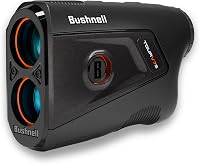
The Bushnell Tour V6 Shift pairs a flashing visual ring and vibration when it locks onto the flag. Its external slope switch lets you turn slope compensation off for tournament-legal play.
Bushnell states a 5–1,300-yard range and 6x magnification. The BITE magnetic mount attaches to a golf cart or another metal surface for quick access.
Consider it if you want both visual and tactile flag-lock signals and expect to use a cart mount. It includes a case, microfiber cloth, quick-start guide and CR2 battery.
Nikon Coolshot ProIII Stabilized: steadier targeting
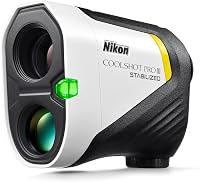
The Nikon Coolshot ProIII Stabilized is made for golfers who want image stabilization and flag-lock confirmation. Nikon describes its HYPER READ system as displaying a measurement in 0.1 seconds.
It offers Golf Mode with slope compensation and Actual Distance Mode for tournament play. Nikon also describes a visual indicator and vibration when the device detects a flagstick.
Consider it if hand movement makes it difficult to keep the view on a target. It uses a CR2 battery, has a 6x view and comes with a case.
What should you check before choosing a golf rangefinder?
Check the controls, target signals, carry method and power against the way you play. A longer stated range or higher magnification may matter less than a mode you can read and use correctly.
- Target signals: Decide whether vibration alone is enough or you want a visual signal too.
- Slope mode: Check how to turn it off and confirm whether your event permits slope adjustment.
- Magnification and steadiness: Compare 6x and 7x options, and consider stabilization if holding a target is difficult.
- Carry: Look for a cart magnet, belt clip or case that fits your routine.
- Power: Choose between a replaceable battery and a rechargeable design, then check that you can keep it ready.
- Weather and care: Read the specific model's water-resistance information and follow its care instructions.
Compare these features with your own priorities instead of choosing by one headline number. Our best golf rangefinders for everyday golfers guide can help you compare more models.
Which features matter most for your round?
Pick a model based on the feature that solves your main problem. Choose a visible slope switch if you want a clear way to disable slope, stabilization if steady aiming is difficult, or a cart mount if you ride often.
If you're still deciding between laser and other distance tools, start with golf rangefinders explained. Then compare the controls and carry options against how you play.
Frequently asked questions
What is the most important feature in a golf rangefinder?
Start with reliable aiming and a clear way to confirm the target is the flag, especially when trees or other objects sit behind it. Then decide whether slope adjustment, a visible slope switch, a magnet or image stabilization matters for how you play.
The best feature set is the one you can use confidently.
Is slope useful on a golf rangefinder?
Slope can show a distance adjusted for uphill or downhill elevation, which can help you plan a shot. For competition, check the applicable rules and use a model's actual-distance mode or switch slope off when required.
A visible control makes it easier to confirm which mode is active.
Do you need 7x magnification for golf?
No. Magnification can make a distant target appear larger, but it doesn't guarantee an easier reading.
A steady view, comfortable eye placement and clear target confirmation may matter more.
Compare how a 6x or 7x view suits you if you can, and don't choose by magnification alone.
Are golf rangefinders accurate to one yard?
Some models state an accuracy of about one yard, while others claim a smaller margin. Those figures describe a maker's stated measurement performance, not a promise that every reading will be correct.
Target selection, aiming steadiness and what you measure all affect whether the number answers your question.
Should you choose a rangefinder with a magnet?
A built-in magnet can keep a rangefinder on a metal golf cart frame for quick access, if the model supports that use. A magnet doesn't help if you carry your bag or walk most rounds.
Consider how you move around the course and whether a case or belt clip fits better.