9 Best Golf Rangefinders for Everyday Golfers (October 2026)
The best golf rangefinders for everyday golfers include the Bushnell Tour V7 Shift for quick yardage decisions, the Nikon Coolshot ProIII Stabilized for a steadier view, and the Garmin Approach Z82 for laser and course maps.
On this page (4 sections)
The Bushnell Tour V7 Shift is the best golf rangefinder for most everyday golfers, because it shows slope-adjusted and actual yardage in different colors and recalls the last distance you measured. For stabilized optics, choose the Nikon Coolshot ProIII; for course maps in the viewfinder, consider the Garmin Approach Z82.
A laser rangefinder gives you the distance to a target you aim at, such as a flag or hazard. GPS can show green distances without aiming, while hybrid models combine both approaches.
Our guide to laser, GPS and hybrid golf range finders explains which style fits your routine.
Our picks at a glance
-
1

-
2
-
3

How we chose these golf rangefinders
We compared the listed features with common everyday needs: readable yardages, clear target confirmation, useful slope controls and easy ways to carry or recharge a device. We also considered whether each option adds GPS, stabilization or other tools that solve a specific problem.
Our score weighs specs, features and buyer feedback against what you're shopping for. The scores reflect how well each model's stated features fit everyday golf, rather than direct product experience.
| Product | Best for | Range | Magnification | Display | Our score |
|---|---|---|---|---|---|
| Bushnell Tour V7 Shift | quick yardage decisions | Up to 1,300 yards | 6x | Dual-color OLED | 9.3 |
| Nikon Coolshot ProIII Stabilized | a steadier view | Up to 1,200 yards | 6x | 8.9 | |
| Garmin Approach Z82 | laser and course maps | 8.8 | |||
| Blue Tees Captain Pro | connected GPS and laser | Up to 1,200 yards | 7x | 8.7 | |
| Bushnell A1-Slope | a compact carry | 6x | 8.6 | ||
| Callaway 300 Pro | a simple slope switch | 5–1,000 yards | 6x | 8.5 | |
| Blue Tees Series 3 Max+ | display contrast changes | Up to 1,000 yards | 6x | 8.4 | |
| REDTIGER Slope Rangefinder | multiple measurement modes | Up to 1,200 yards | 7x | 8.1 | |
| Acer Gadget | anti-shake targeting | 800 yards | 6x | 7.9 |
The best golf rangefinders for everyday play
The Tour V7 Shift is the most balanced choice here for reading adjusted and actual distances, while the other models suit more specific preferences. Start with the feature you'll use most during a round.
Bushnell Tour V7 Shift: Best for quick yardage decisions
- Dual-color OLED display
- Slope-adjusted and actual yardage colors
- Yardage range recall
- PinSeeker with Visual JOLT
The two-color display separates slope-adjusted and actual distance, while range recall brings back the last measured yardage. LINK can pair with Bushnell and Foresight launch monitors for club suggestions based on your yardage data.
Pros
- Slope and actual yardage use different colors
- Recalls the last measured distance
- PinSeeker with Visual JOLT
Cons
- LINK suggestions depend on a compatible launch monitor
The Tour V7 Shift suits golfers who want slope-adjusted and actual yardage easy to tell apart. Its dual-color OLED shows the slope-adjusted “plays-like” number in green and actual distance in red, so you can see which figure you're reading.
Yardage Range Recall brings back your last measured distance with one press. That can help when you want to double-check a previous target or review distances during practice.
PinSeeker with Visual JOLT is designed to help confirm flag acquisition. The rangefinder also supports LINK pairing with Bushnell and Foresight launch monitors, which can show club suggestions based on your own yardage data.
Choose it if the color-coded display and range recall match the way you make club decisions. If you mainly want a simpler compact model, compare it with our small golf rangefinder picks.
Nikon Coolshot ProIII Stabilized: Best for a steadier view
- Image stabilization
- 0.1-second Hyper Read
- Dual visual and vibration pin confirmation
- Golf and Actual Distance modes
Nikon's stabilization helps steady the view and laser for targeting. Dual LOCKED ON QUAKE gives visual and vibration confirmation when the rangefinder detects a flagstick.
Pros
- Stabilized optics
- Fast measurement system
- Separate actual-distance mode
Cons
- Not water resistant
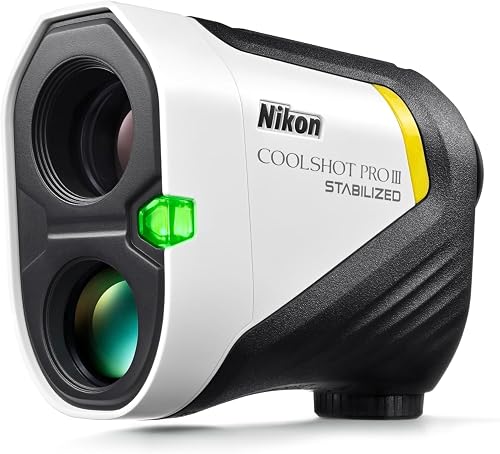
The Nikon Coolshot ProIII Stabilized is the pick for golfers who want help keeping the view steady while aiming. Its image stabilization is designed to reduce the effect of hand movement, and Hyper Read provides a measurement in 0.1 seconds.
When the rangefinder detects a flagstick, Dual LOCKED ON QUAKE gives visual and tactile confirmation. Golf Mode provides slope-adjusted distances, while Actual Distance Mode displays actual distance for competition play.
Nikon lists the rangefinder as rainproof in its product description, but its water resistance specification says “Not Water Resistant.” Treat it as a device to protect from wet conditions and check Nikon's care guidance before using it in rain.
Choose this model if stabilization and a separate actual-distance mode are high priorities. For more choices centered on readable controls and straightforward operation, see our easy-to-use golf rangefinders.
Garmin Approach Z82: Best for laser and course maps
- 2-D CourseView maps for more than 41,000 courses
- Laser Range Arc
- Hazard view
- Image stabilization and vibration feedback
The Approach Z82 pairs laser readings with full-color 2-D course maps in the viewfinder. Its Laser Range Arc and hazard view add course context to the target distance.
Pros
- Course maps appear in the viewfinder
- Hazard view scrolls through hazards
- Image stabilization
Cons
- More course information may be unnecessary if you only want a laser distance
The Garmin Approach Z82 is for golfers who want laser distance and mapped course context in one viewfinder. Full-color 2-D CourseView maps cover more than 41,000 courses worldwide, and the Laser Range Arc shows the measured distance on the map.
Hazard view lets you scroll through hazards on the course map. Image stabilization helps with flag targeting, and vibration feedback signals when you've locked in.
This model makes the most sense if you want course information alongside a direct laser measurement. If you'd rather see green distances on your wrist, our golf rangefinder watch guide covers that format.
Blue Tees Captain Pro: Best for connected GPS and laser

- GPS front, center and back distances
- Laser rangefinder
- Magnetic cart mount
- USB-C rechargeable
Captain Pro combines GPS green distances with laser measurements and app features for shot tracking and club suggestions. Its built-in magnet keeps it close at a cart.
Pros
- GPS and laser in one device
- Magnetic cart mount
- USB-C charging
Cons
- App-connected features add another setup step
The Blue Tees Captain Pro suits golfers who want GPS and laser distance in one device. GPS provides front, center and back green distances, while the laser measures a chosen target.
It also connects with the Blue Tees GAME app for features such as shot tracking, club suggestions and performance insights. The built-in cart magnet keeps it close at hand, and the device is USB-C rechargeable with an IP67 waterproof rating.
Choose it if you expect to use both GPS context and laser targeting, along with the app features. For a closer look at cart-side storage options, see our guide to magnetic golf rangefinders.
Bushnell A1-Slope: Best for a compact carry

- Pocket-size design
- Slope on/off switch
- Magnetic BITE skin
- USB-C rechargeable
The compact A1-Slope is built for golfers who want a smaller laser with slope adjustment. The included magnetic skin, carry case and rechargeable battery support easy course carry.
Pros
- Compact 5.1 oz design
- Slope can be switched off
- Magnetic skin and USB-C charging
Cons
- Flag range is specified at 1–350 yards
The Bushnell A1-Slope is the compact pick for golfers who want a smaller rangefinder with slope adjustment. It weighs 5.1 oz, uses 6x magnification and includes a magnetic BITE skin for attaching to a compatible cart surface.
Its slope mode can be toggled off, and PinSeeker with JOLT uses a short vibration to confirm a flag lock. Bushnell says the rechargeable battery lasts more than 50 rounds, and the box includes a USB-C charging cord and carry case.
The specified flag range is 1–350 yards, with a total range up to 1,300 yards. Choose it if compact carry matters more than having GPS course maps or a hybrid display.
Callaway 300 Pro: Best for a simple slope switch

- External slope on/off switch
- Pin Acquisition Technology
- Pulse vibration
- Integrated cart magnet
The external switch makes it straightforward to turn slope off for tournament play. A pulse confirms pin acquisition, and the integrated magnet offers a cart-side storage option.
Pros
- External slope switch
- Pulse confirms pin lock
- Integrated cart magnet
Cons
- Pin locking is specified up to 300 yards
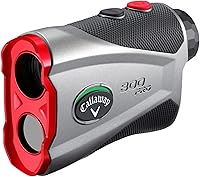
The Callaway 300 Pro fits golfers who want an external slope switch and familiar target confirmation. Its switch turns slope off for tournament play, while Pin Acquisition Technology and a short pulse help confirm a pin reading.
Callaway specifies 6x magnification and a range of 5–1,000 yards. The integrated magnet can attach to a compatible cart frame, and the included hard case has a carabiner and quick-close band.
Choose this model if you want slope adjustment with a physical switch and a cart magnet. To understand what a yardage reading can and cannot tell you, read how accurate golf rangefinders are.
Blue Tees Series 3 Max+: Best for display contrast changes

- Auto-Ambient display
- Slope switch
- Flag Lock vibration
- Built-in magnetic strip
The display changes text between red and black based on light conditions. A slope switch, vibration flag lock and magnetic strip cover several common course-use needs.
Pros
- Display adapts text color to lighting
- Slope switches off
- Built-in magnetic strip
Cons
- Water-resistant rating is IPX4
The Blue Tees Series 3 Max+ helps with display contrast by changing its text between red and black based on lighting conditions. Its slope switch lets you turn slope off, and Flag Lock uses short vibration pulses to confirm a target.
A built-in magnetic strip supports quick access on a cart or another metal surface. The rangefinder has 6x magnification and a stated range of up to 1,000 yards, with a water-resistant IPX4 rating.
Pick it if an adaptive display and magnetic storage are more useful to you than GPS features. See our Blue Tees Series 3 Max+ review for a closer model-focused look.
REDTIGER Slope Rangefinder: Best for multiple measurement modes

- Slope on/off
- Six measurement modes
- USB-C charging
- Magnetic strip
REDTIGER includes slope, flag locking, horizontal and height ranging, speed and continuous scan modes. USB-C charging and a magnetic strip add practical carry options.
Pros
- Six measurement modes
- Slope can be switched off
- USB-C charging
Cons
- Several modes may take time to learn
The REDTIGER Slope Rangefinder offers six measurement modes, including slope compensation, flag locking, horizontal and height ranging, speed and continuous scan. The mode range suits golfers who want more than a single distance function.
It also has 7x magnification, USB-C charging and an included magnetic strip. The maker describes it as IP54 water resistant, while the specification lists IPX4, so check the care instructions before exposing it to wet conditions.
Choose it if multiple measurement modes matter to you. If you prefer a single-purpose device, a more basic laser may be easier to operate between shots.
Acer Gadget: Best for anti-shake targeting

- Anti-shake technology
- Slope on/off
- Flaglock vibration
- USB-C rechargeable
Acer Gadget combines anti-shake targeting with slope adjustment, vibration flag lock and six measurement modes. The stated range is 800 yards.
Pros
- Anti-shake feature
- Rechargeable by USB-C
- Slope can be switched off
Cons
- Shorter stated range than the other picks
The Acer Gadget rangefinder is a lower-range option with anti-shake technology and a stated range of 800 yards. It also includes slope on/off, flaglock vibration and USB-C charging.
Its six modes cover slope compensation, vertical and horizontal distance, angle, speed and scanning. The product information identifies the model as an 800-yard version, so check the exact variant before ordering if you need a different range.
Choose Acer if anti-shake targeting and rechargeable power matter more than maximum reach. For help deciding whether a laser fits your rounds, read what makes a good golf rangefinder.
Which golf rangefinder features matter most?
The best golf rangefinder is the one whose readings and controls fit how you play. For many golfers, the useful basics are a readable display, a clear flag-lock signal and a slope setting that can be turned off when needed.
Is slope adjustment useful on a golf rangefinder?
Slope adjustment can show a distance adjusted for uphill or downhill shots, which gives you another piece of information when selecting a club. It doesn't replace your judgment about wind, lie or how far you usually hit each club.
If you play in events, confirm the rules and use a model with a clear slope-off control. The Callaway 300 Pro has an external switch, while several other picks here also provide a way to turn slope off.
Do you need GPS with a laser rangefinder?
GPS can show front, center and back green distances without aiming at a target. A laser gives a measurement to a specific point, which can help when you want the distance to a flag or visible hazard.
A hybrid such as the Blue Tees Captain Pro combines both. For dedicated GPS devices, see our handheld golf GPS guide.
What helps you lock onto a flag?
A flag-lock feature can signal when the rangefinder has detected the pin rather than a background object. Models in this roundup use different cues, including vibration, visual indicators or both.
Stabilization can also help if keeping the view steady is difficult. Compare the Nikon's stabilization with the choices in our golf rangefinder accuracy guide before deciding which targeting help you need.
Which golf rangefinder should you choose?
Choose the Bushnell Tour V7 Shift if color-coded slope and actual distances plus yardage recall fit your routine. Pick the Nikon Coolshot ProIII Stabilized for stabilized targeting, the Garmin Approach Z82 for mapped course context, or the Blue Tees Captain Pro for GPS and laser together.
If compact carry is your main concern, compare the Bushnell A1-Slope with our small golf rangefinder guide. For cart storage, the magnetic rangefinder guide can help narrow the choice.
Our top 3 picks at a glance
-
1
-
2
-
3
Frequently asked questions
What is the best golf rangefinder for most golfers?
The Bushnell Tour V7 Shift is a strong everyday choice if you want slope-adjusted and actual distances shown in different colors. Its range recall also brings back your last measured yardage.
If steady targeting matters more, consider the Nikon Coolshot ProIII Stabilized.
Should I choose a golf rangefinder with slope?
Slope can help you account for uphill and downhill shots by showing an adjusted distance. If you play events where slope use is restricted, choose a model with a clear way to turn it off and check the event rules.
The Callaway 300 Pro has an external slope switch.
Is a laser or GPS golf rangefinder better?
A laser measures a specific target such as a flagstick, while GPS can show front, center and back distances without aiming at the target. A hybrid combines both approaches.
See our laser, GPS and hybrid guide for help choosing a format.
What features make a golf rangefinder easier to use?
Look for clear display contrast, a simple way to confirm a flag lock and controls you can understand without pausing play. Stabilization may help if you find it hard to hold a target steady.
Our easy-to-use golf rangefinder guide covers those details.
Can I use a golf rangefinder on a cart?
A built-in magnet or magnetic accessory can keep a rangefinder within reach on a compatible cart surface. Check how the mount attaches and keep the device in its case when it is not secured.
The magnetic golf rangefinder guide compares options for cart riders.