9 Best Golf Rangefinders for Beginners (November 2026)
The best golf rangefinders for beginners include the REVASRI Range Finder for Golf for first rounds, the Gogogo Sport Vpro GS24 for cart and bag carry, and the WOSPORTS Golf Rangefinder with Slope for reading uphill and downhill shots.
On this page (5 sections)
The best golf rangefinder for beginners is the REVASRI NK1000, a light 4.3 oz model with one-button measuring and a slope switch you can turn off for tournaments. If you want a magnet for the cart and a longer reach, the Gogogo Sport Vpro GS24 is the other top pick.
Beginners rarely need every feature on a rangefinder. What matters early is a clear view of the pin, a number you can trust and controls you can learn in a few minutes.
Most of the models on this list carry functions you will not touch until your second season.
If you are still working out what these devices do, our guide to what a golf rangefinder is covers the basics first. Then come back here to choose a model.
Our picks at a glance
-
1
-
2

-
3
 Best for reading uphill and downhill shots
WOSPORTS Golf Rangefinder with Slope
8.7/10 our score
See it on Amazon
- 4
 Best for pin hunting from far outCheck it
- 5
 Best for clipping to the cartCheck it
- 6
 Check it
MOESAPU Golf Range Finder with Slope
Best for long practice sessions - 7
 Best for extra carrying choicesCheck it
- 8
 Check it
SILLAID Golf Rangefinder with Slope
Best for clear sight in bright sun - 9
 Best for steady aim with shaky handsCheck it
Which rangefinders suit new golfers best?
The top scores here go to models that keep the controls simple while still offering slope, flag lock and a tournament-legal mode. Each pick below solves a slightly different early-golfer problem.
The write-ups are ordered by how well each one fits a first buyer, not by price.
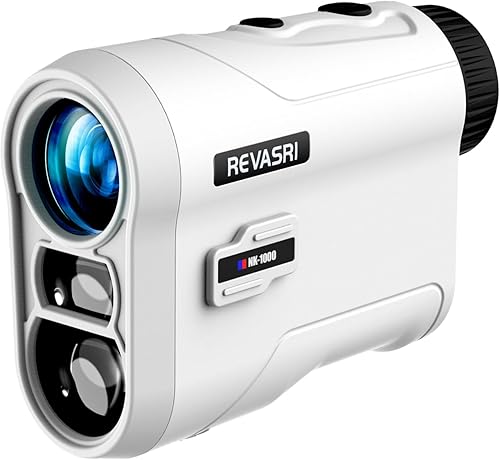
REVASRI Range Finder for Golf: Best for first rounds
- 5-1000 yards
- ±1 yard accuracy
- 0.5s measurement
- Slope on/off
- Pin lock with vibration
- USB-C rechargeable
- 6.5x magnification
- 4.3 oz
One button measures and another switches units, so there is little to learn before your first round. The slope switch makes it legal for tournament play when turned off.
Pros
- One-button measuring
- Slope off for tournaments
- Light at 4.3 oz
- USB-C charging
Cons
- Uses a smaller lens than the SILLAID
- Water rating is IP54, not full waterproofing
The REVASRI NK1000 suits a player buying a first rangefinder and wanting to learn one set of controls. One button measures and a second changes between meters and yards.
That is the whole learning curve.
Its slope switch is the feature beginners get the most from. With slope on, the screen shows the angle, the straight-line distance and a club-adjusted distance on hills.
Turn slope off and the angle disappears, but flag lock and vibration keep working.
At 4.3 oz and 3.8 by 2.6 by 1.3 inches, it disappears into a pocket or bag. The fully multi-coated lens brightens the view on dull mornings.
The 6.5x magnification sits between the 6x and 7x models here and gives a wide enough view to find the pin quickly.
It charges by USB-C and comes with a pouch, carabiner and lens cloth. That saves hunting for batteries before a round, and the low battery indicator warns you before the cell dies mid-round.
The trade-off against the bigger models here is reach and light gathering. Its 1000-yard range and smaller lens are plenty for course pins, but long-range practice targets favor the 1200-yard picks.
The IP54 rating covers splashes, not a soaking.
Gogogo Sport Vpro GS24: Best for cart and bag carry
- 5-1200 yards
- ±0.1m accuracy
- 7x magnification
- Slope switch
- Pin-seeking with vibration
- Magnetic mount
- AAA battery
- IP54
A magnetic mount keeps it on the cart frame, and the slope switch gives a tournament-legal mode when you need one. The 1200-yard range covers long practice targets as well as pins.
Pros
- Magnetic mount
- 7x magnification
- Slope switch
- Long 1200-yard range
Cons
- Runs on AAA batteries
- Heavier than the REVASRI NK1000
The Gogogo Sport Vpro GS24 earns the same score because it adds two things new golfers use constantly: a magnetic mount and a 1200-yard range. The magnet holds the unit to the cart frame, so it stays within reach between shots.
Its 7x magnification pulls the flag closer than the 6x models here. Pin-seeking with vibration confirms the flag is locked, and the MTL version's slope switch turns the slope function off for tournament play.
ARC angle compensation works for both golf and hunting, so it carries over if you also shoot or bowhunt.
Accuracy is quoted at ±0.1m. The flagpole lock works to 150 yards on the pole alone and up to 250 yards when you aim at an unfolded flag, which covers most approach shots a beginner faces.
Continuous range readings let you sweep across a green and watch the number change.
The GS24 runs on AAA batteries rather than a built-in cell. That means no charging routine, but you do need spares in the bag.
It is the heavier of the two top picks at 184 g. For a beginner who walks and carries, the REVASRI's lighter body may feel easier over 18 holes.
WOSPORTS Golf Rangefinder with Slope: Best for reading uphill and downhill shots
- 5-1200 yards
- 0.5-yard accuracy
- 6x magnification
- Slope on/off
- 4 measurement modes
- 0.5s flag lock with vibration
- Magnetic mount
- IPX4
Slope compensation gives an adjusted distance on hills, and the flag lock confirms the pin with a short vibration. Four modes add angle and vertical readings for practice.
Pros
- Slope compensation
- Four measurement modes
- Magnetic cart mount
- Two-button operation
Cons
- IPX4 is lighter protection than IP54
- Slower focus than the REVASRI models
WOSPORTS suits the beginner whose home course rolls. Slope compensation measures the incline or decline and gives an adjusted distance, which takes guesswork out of club choice on hills.
The brand quotes up to 0.5-yard accuracy and a 5 to 1200-yard range.
The four modes cover straight-line distance, angle, continuous scan and vertical distance. A beginner can ignore most of that at first and still use the main measuring mode.
The adjustable eyepiece is the useful extra here: it lets you focus the view to your own eyesight instead of settling for a fixed focus.
Flag lock works in about 0.5s with a vibration confirmation. Two-button operation and yard/meter switching keep the controls basic, and the magnetic stripe attaches to a cart.
The slope-off mode keeps it legal for competition.
IPX4 protection handles light rain and morning dew, though it is lighter than the IP54 rating on several rivals. At 145 g it sits in the middle of this group on weight.
The 6x magnification is a step below the 7x models, so the pin looks smaller in the viewfinder. Its 2-year manufacturer warranty is longer than most here.
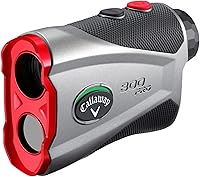
Callaway 300 Pro: Best for pin hunting from far out
- 5-1000 yards
- ±1 yard accuracy
- 6x magnification
- External slope switch
- Pin Acquisition Technology to 300 yards
- Pulse vibration
- Magnahold cart mount
- IPX4
The external slope switch is easy to flip before a tournament round, and the pin lock reaches 300 yards. Callaway's pulse vibration tells you the flag is captured.
Pros
- External slope switch
- Pin lock to 300 yards
- Strong cart magnet
- Molded hard case
Cons
- 8 oz makes it one of the heavier picks here
- IPX4 rating rather than full waterproofing
Callaway's 300 Pro suits the beginner who plays longer courses and wants to lock the pin from a distance. Pin Acquisition Technology reaches 300 yards, further than the flag locks on most models here.
On a long par five, that reach means the lock still works when the flag is small in the view.
The external slope switch is the friendliest design in this group for tournament days. Flip it off and the slope reading stops, with no menu to work through.
The device still measures the angle of incline and decline when slope is on, then calculates the adjusted distance.
Magnification is 6x and the range is 5 to 1000 yards at ±1 yard. A pulse vibration fires when the pin is captured, and the Magnahold magnet fixes it to the cart frame.
The 6x view is wider than the 7x models, which some beginners find easier for finding the flag in the first place.
At 8 oz it is one of the heavier models here. That matters if you carry your bag rather than ride, and it also makes the unit bulkier in a pocket.
Callaway includes a molded hard case with a carabiner and an elastic quick-close band. It protects the rangefinder in a bag that gets knocked about, which is a real plus for a first device.
REVASRI Range Finder for Golf: Best for clipping to the cart
- 5-1000 yards
- ±1 yard accuracy
- Slope on/off
- Pin lock with vibration
- Side magnet
- USB-C rechargeable
- 5.43 oz
A side magnet holds this model on the cart frame, and the slope mode switches with a top button press. Pin lock and vibration work in both modes.
Pros
- Built-in side magnet
- USB-C rechargeable
- Slope on/off switch
- Slim body
Cons
- IP54 rather than IPX4
- Heavier than the NK1000 version
This second REVASRI model suits the beginner who wants the rangefinder to live on the cart. A side magnet attaches it to the frame, so it is always in the same spot when you walk up to the ball.
The 5.43 oz body is slim enough to slide into a pocket when you leave the cart.
Slope switches on and off with a press of the top mode button. In both modes you keep flag lock and vibration, so the pin confirmation does not disappear when slope does.
The description puts pin-seeking at up to 250 yards, and the single ranging mode skips slope compensation entirely when you just want a straight distance.
Range is 5 to 1000 yards at ±1 yard. The 6x magnification and 4.13 by 2.95 by 1.5 inch body make it easy to grab and hold.
USB-C charging with smart power saving means fewer top-ups. The included pouch, carabiner and lens cloth cover the basics for a new player.
The trade-off is that the NK1000 at the top of this list does the same core job at a lighter weight. Choose this one only if the cart magnet matters more to you than 1.1 oz.
MOESAPU Golf Range Finder with Slope: Best for long practice sessions
- 5-1200 yards
- ±1 yard accuracy
- 7x magnification
- Slope on/off
- 0.5s flag lock with vibration
- Magnetic mount
- USB-C rechargeable
- IP54
MOESAPU says the USB-C battery runs about 15,000 measurements per charge. The transflective LCD stays readable in sun or shade, which helps on bright afternoons.
Pros
- Long battery life per charge
- Readable LCD in sunlight
- 7x magnification
- Magnetic mount
Cons
- Heavier at 6.4 oz
- IP54 dust and splash protection only
MOESAPU suits the beginner who practices a lot and does not want to charge often. The brand says its USB-C battery covers about 15,000 measurements per charge, which stretches across many range sessions.
A battery indicator keeps you informed before the cell runs down.
Its transflective LCD stays readable in sun or shade. Beginners often struggle when the display washes out on a bright day, and this screen is built for that.
The 7x magnification and 1200-yard range put it near the top of this group for reach, with ±1 yard accuracy.
Flag lock fires in about 0.5s with a vibration. Slope compensation switches on and off instantly, and continuous scan tracks several targets in real time.
That scan mode is handy when you want the distance to a bunker lip as well as the pin.
The magnetic mount and non-slip grip help when you hold it one-handed. At 6.4 oz it is heavier than the light REVASRI models.
IP54 dust and splash protection covers dew and light rain but not a soaking. The brand also lists hunting and hiking as uses, so it can double as a general distance tool.
REDTIGER Slope Rangefinder: Best for extra carrying choices
- 5-1200 yards
- 0.5-yard accuracy
- 7x magnification
- Slope switch
- 6 measurement modes
- Magnetic strip and belt clip
- USB-C rechargeable
- IP54
REDTIGER packs a magnetic strip plus a magnetic belt clip, so it can ride on the cart or your bag. Six modes cover slope, flag lock, horizontal and height ranging, speed and scanning.
Pros
- Belt clip and cart magnet
- Six measurement modes
- USB-C charging
- 7x magnification
Cons
- Heavier than the lightest picks
- More modes than a beginner needs at first
REDTIGER suits a beginner who moves between cart and carry. A magnetic strip attaches to the cart or a metal club, and an included magnetic belt clip lets you wear it or hang it on the bag.
That is the most carrying options of any model here.
Six modes cover slope compensation, flag locking, horizontal and height ranging, speed measuring and continuous scan. A beginner will use slope and flag lock most, then grow into the rest.
The horizontal and height readings are the useful pair for practice, since they break a target down into two numbers instead of one.
Accuracy is quoted at 0.5 yards with 7x magnification. The transflective LCD keeps readings clear and quick, and the slope switch makes it legal for competition play.
Range runs 5 to 1200 yards, and the unit is IP54 water resistant.
USB-C charging is rated for 30,000 uses. The package adds a soft case, hand rope and lens cloth.
At 6.4 oz it is heavier than the lightest picks, and six modes mean more button presses to learn. The belt clip adds bulk compared with a plain pouch.
The 2-year warranty and lifetime technical support are among the best terms here.
SILLAID Golf Rangefinder with Slope: Best for clear sight in bright sun
- 1200 yards
- ±0.5 yard accuracy
- 7x magnification
- External slope switch
- Pin lock with vibration
- 19mm objective lens
- USB-C rechargeable
- Magnetic mount
The 19mm lens and multi-coated glass give a brighter view when the sun is harsh. An external slide switch turns slope off for tournament rounds without a menu.
Pros
- Large lens for bright conditions
- External slope switch
- Pin lock with pulse
- Magnetic cart mount
Cons
- Shorter measurement time claim than rivals
- Water resistance is not full waterproofing
SILLAID suits the beginner who plays in strong sun and wants a bright, clear view. Its 19mm objective lens with 85% multi-coated light transmittance gives a balanced sight in bright or overcast weather.
The larger lens gathers more light than the compact models, which matters most in low morning light.
An external slide switch with red and green indicators toggles slope on and off. That is quicker than a menu and keeps the rangefinder compliant with tournament rules.
Slope mode calculates an adjusted distance for uphill and downhill shots when it is on.
Pin lock with pulse vibration confirms the flag, and the brand claims a 0.02s measurement time. Range reaches 1200 yards at ±0.5 yards, with a one-button switch between yards and meters.
The built-in magnet snaps to the cart frame. Modes cover line distance, pin lock, slope, horizontal and vertical readings and speed.
Its 7x magnification matches the other long-range picks. The main trade-offs are water resistance that is not rated as full waterproofing and a review count far smaller than the top models.
Keep it out of heavy rain and expect to be an early adopter.
Acer Gadget: Best for steady aim with shaky hands
- 800 yards
- ±0.5 yard accuracy
- 6x magnification
- Slope on/off
- Anti-shake technology
- Flag lock with vibration
- USB-C rechargeable
Anti-shake technology helps steady the view when your hands are not rock solid. The 800-yard range is enough for most course pins but shorter than the rest here.
Pros
- Anti-shake helps steady aim
- Slope on/off
- Flag lock with vibration
- USB-C rechargeable
Cons
- Shortest range in this group
- Heaviest model at 11.2 oz
The Acer Gadget suits the beginner whose hands are not steady. Anti-shake technology steadies the reading, which helps when you are nervous on the first tee or holding the unit one-handed.
For a new golfer still learning to brace the device, that is a real comfort feature.
Its 800-yard range covers most course pins but falls short of the 1200-yard models. For a new golfer playing standard courses, that is rarely a limit, though the practice range may want more reach.
The brand also pitches it for hunters tracking targets.
Flag lock works to 800 yards with vibration. Accuracy is ±0.5 yards and magnification is 6x, with a bright LCD for clear readings.
Six modes cover slope compensation, vertical and horizontal distance, angle, speed and scanning. The slope switch makes it tournament legal when off.
USB-C charging removes battery swaps. At 11.2 oz it is the heaviest model here, so it is better suited to a cart than a carry bag.
The bulk is the price you pay for the anti-shake help.
How these rangefinders compare side by side
| Product | Best for | Range | Magnification | Weight | Our score |
|---|---|---|---|---|---|
| REVASRI Range Finder for Golf | first rounds | 5-1000 yd | 6.5x | 4.3 oz | 9.3 |
| Gogogo Sport Vpro GS24 | cart and bag carry | 5-1200 yd | 7x | 9.3 | |
| WOSPORTS Golf Rangefinder with Slope | reading uphill and downhill shots | 5-1200 yd | 6x | 145 g | 8.7 |
| Callaway 300 Pro | pin hunting from far out | 5-1000 yd | 6x | 8.5 | |
| REVASRI Range Finder for Golf | clipping to the cart | 5-1000 yd | 6x | 5.43 oz | 8.5 |
| MOESAPU Golf Range Finder with Slope | long practice sessions | 5-1200 yd | 7x | 8.3 | |
| REDTIGER Slope Rangefinder | extra carrying choices | 5-1200 yd | 7x | 8.1 | |
| SILLAID Golf Rangefinder with Slope | clear sight in bright sun | 1200 yd | 7x | 8.0 | |
| Acer Gadget | steady aim with shaky hands | 800 yd | 6x | 11.2 oz | 7.9 |
How we chose these beginner rangefinders
We compared each model's stated range, accuracy, magnification, weight and water rating against what a new golfer actually needs. Slope switching, flag lock and charging method carried extra weight, because those decide how easy the device is to live with round after round.
A model that measures well but fights you on every shot is not a beginner's friend.
We then set scores by how well each one fits a first rangefinder buyer. Reach matters, but so does a clear view of the pin and controls you can learn without a manual.
A 1200-yard range earns little if the screen washes out or the flag lock misses.
We favored models with a slope switch over fixed slope. A switch lets you learn with slope help and still play in tournaments where slope must be off.
Every pick here has one. Fixed slope would have narrowed your options later.
Weight and mounting got attention too. A beginner walking 18 holes feels an extra 7 oz, so the lightest models rank well.
A cart magnet or belt clip earns points for players who ride. Battery type split the group as well: rechargeable units avoid the spare-battery routine, while AAA models never need a cable.
Our score weighs specs, features and buyer feedback against what you're shopping for. No single number decides it.
A model that wins on range but loses on comfort drops down the list.
What should a beginner check before buying a rangefinder?
Buy for the way you play, not for the longest feature list. A slope switch, a clear viewfinder and a weight you can carry all decide whether the device helps or sits in the bag.
The questions below are the ones beginners ask most, answered in plain terms.
Should you buy a slope model or a plain one?
Buy a slope model with a switch. Slope gives an adjusted distance on hills, which helps new players pick a club.
The switch turns the feature off when a tournament rule requires it. With the feature on, you get the angle, the sight of line distance and the compensated distance together.
Fixed-slope models without a switch limit you to casual rounds. Every pick on this list has a switch or a mode button, so you keep the option either way.
If you mostly play social rounds and never enter competitions, a fixed slope model would still work, but the switch costs you nothing.
How much magnification do you need?
6x is enough to see the pin clearly on a normal course. 7x pulls the flag closer and suits long holes and practice targets.
Higher magnification narrows the view and makes the unit harder to hold steady. The 6.5x on the REVASRI NK1000 is a reasonable middle ground.
Beginners should favor a steady, wide view over the strongest zoom. Anti-shake, as on the Acer Gadget, helps more than a bigger number when your hands move.
A wide view also makes it easier to find the flag through the eyepiece in the first place.
Is a cart magnet worth it?
Yes, if you ride a cart most rounds. A magnet keeps the rangefinder in one spot, so you are not digging through a bag between shots.
The Gogogo, Callaway and both REVASRI models offer some form of mount. REDTIGER goes further with a magnetic belt clip as well as a strip.
Walkers get less from a magnet and more from low weight. A pouch with a carabiner, like the one with the REVASRI NK1000, clips to the bag instead.
Pick your carry style first and let the mounting follow.
Should you pick rechargeable or battery power?
Rechargeable rangefinders remove the spare battery routine. USB-C models here charge from a common cable, so one charger can cover phone and rangefinder.
The MOESAPU's stated 15,000 measurements and the REDTIGER's 30,000-use rating show how far a charge can stretch. The catch is that a flat cell ends the round unless you carry a power bank.
AAA models like the Gogogo never need charging, but you must keep spares in the bag. For a forgetful beginner, a rechargeable with a charge-after-every-round habit is simpler.
For someone who wants zero charging routine, the AAA model wins.
How do you know a rangefinder is tournament legal?
Check that the slope function can be switched off. When it is off, the device shows straight-line distance only, which is what most tournament rules allow.
The Callaway 300 Pro and SILLAID use external switches that are quick to flip. The REVASRI models use a mode button instead.
Rules vary by competition, so read the local rule before you play. If you want to compare more models with slope switches, our roundup of the best golf rangefinders with slope goes deeper.
What makes a good rangefinder for golf in general?
Accuracy, a clear view and controls you can use under pressure matter more than extra modes. Our guide to what makes a good rangefinder for golf breaks down the features worth paying for and the ones you can skip.
A wide, bright view often beats a longer spec sheet number.
For a wider field of models beyond beginner picks, see the full list of golf rangefinders for everyday players.
Which beginner rangefinder should you buy?
Buy the REVASRI NK1000 if you want the simplest first rangefinder. Its one-button measuring, 4.3 oz body and slope switch make it the best golf rangefinder for beginners who want to learn quickly.
The low battery indicator and USB-C charging round out the easy ownership.
Pick the Gogogo Sport Vpro GS24 for a cart magnet and a 1200-yard range. Choose the Callaway 300 Pro if you hunt pins from far out and want a hard case.
The Acer Gadget is the pick for unsteady hands, while the SILLAID suits bright, sunny courses.
Start with one model and practice with it on the range before your first round. A rangefinder you understand beats a feature-heavy one you never learned to use.
Our top 3 picks at a glance
-
1
-
2
-
3
Best for reading uphill and downhill shots
WOSPORTS Golf Rangefinder with Slope
8.7/10 our score
See it on Amazon
Frequently asked questions
Do beginners need a rangefinder with slope?
Not strictly, but slope helps new players read uphill and downhill shots. A rangefinder with a slope switch lets you turn the feature off for tournament rounds, so you can learn with it and still play by the rules.
How far should a beginner rangefinder reach?
800 to 1000 yards covers almost every pin you will face on a normal course. A longer 1200-yard range helps at the practice range or on long par fives, where you may want the distance to a tree line or bunker.
Are rechargeable rangefinders easier for new golfers?
They remove the need to carry spare batteries. USB-C models here charge from the same cable as many phones.
One drawback is that a flat battery ends the round, so charge it after each use.
How do I hold a rangefinder steady?
Rest your elbows against your body, press the button gently and keep the pin inside the center circle. Models with anti-shake or a strong pin lock make this easier.
Practice on the range before your first round.
What does flag lock vibration do?
It confirms the laser has picked the flagstick rather than trees or a building behind the green. A short vibration fires when the pin is captured.
That signal helps beginners trust the number they read.