Nikon vs Bushnell Rangefinders: Which Is Better? (November 2026)
For most golfers, the Callaway 300 Pro wins this Nikon vs Bushnell-style matchup on features per dollar. It adds an external slope switch legal for tournament play and pin locking to 300 yards, while the Acer Gadget covers slope and vibration for less.
On this page (9 sections)
- Nikon vs Bushnell rangefinders: which brand wins for golf?
- Callaway 300 Pro vs Acer Gadget side by side
- Which has the better slope setup for real rounds?
- Which locks onto the pin more reliably?
- How much range do you actually need on the course?
- Which is easier to carry and use on the cart?
- Where the Acer Gadget makes more sense
- Who should buy which
- The verdict: Callaway 300 Pro or Acer Gadget?
For most golfers, the Callaway 300 Pro is the better buy in this Nikon vs Bushnell rangefinder matchup. It's the highest-scored unit here at 8.5, and it pairs a slope switch that's legal for tournament play with pin locking out to 300 yards.
Nikon and Bushnell are the two names most golfers think of first. This comparison sets that rivalry against what actually decides a purchase: slope handling, pin lock, range and how the unit carries and mounts.
Both products below are golf lasers with slope features. The Callaway 300 Pro sits at the mid-range tier and the Acer Gadget at the budget tier.
If you're still weighing the established brands, our Bushnell Tour V7 Shift review covers one of the flagship models.


Nikon vs Bushnell rangefinders: which brand wins for golf?
Bushnell wins the brand argument for dedicated golf lasers, but the model matters more than the name. Neither Nikon nor Bushnell is the right answer for every golfer, so judge each unit on its slope switch, pin lock and magnification.
Bushnell built its reputation on golf-specific features like slope compensation and pin-seeking tech. Nikon's rangefinder line has leaned more toward hunting and outdoor optics.
That history doesn't decide your purchase, though. A mid-range golf laser from either brand can beat a flagship model that lacks the feature you need.
The two units here skip the brand question. The Callaway 300 Pro is a golf laser from a golf company.
The Acer Gadget is a value-focused golf model with slope. Compare their specs side by side and you'll see the same trade-offs that separate a Nikon from a Bushnell.
One more angle worth knowing: neither Nikon nor Bushnell owns the whole field. There are hunting-first makers and value-first makers putting out credible lasers too.
That's why the brand badge should be the last filter you apply, not the first.
Our Bushnell Tour V5 review shows how the brand's mid-tier model stacks up on paper. And if the price gap between established brands and budget lasers surprises you, our explainer on why Bushnell rangefinders are so expensive breaks down what you're paying for.
Callaway 300 Pro vs Acer Gadget side by side
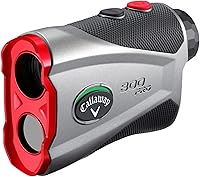
The Callaway 300 Pro leads on range and tournament legality; the Acer Gadget leads on charging convenience and price tier. Here's how the two golf lasers line up.
| Feature | Callaway 300 Pro | Acer Gadget |
|---|---|---|
| Range | 5-1000 yards | 800 yards |
| Magnification | 6x | 6x |
| Accuracy | +/- 1 yard | +/- 0.5 yard |
| Slope | External on/off switch | On/off setting |
| Pin lock | Up to 300 yards with pulse | Flaglock vibration |
| Charging | Lithium battery included | USB-C rechargeable |
| Weight | 8 ounces | 11.2 ounces |
| Water resistance | IPX4 | Not rated |
| Product | Best for | Range | Magnification | Slope | Our score |
|---|---|---|---|---|---|
| Callaway 300 Pro | tournament rounds | 5-1000 yards | 6x | External on/off switch | 8.5 |
| Acer Gadget | budget slope | 800 yards | 6x | On/off | 7.9 |
The table tells the story quickly. The Callaway has the longer stated range and the legal slope switch.
The Acer wins on charging and accuracy spec. Weight favors the Callaway, which matters more than you'd expect when the unit hangs from a cart for 18 holes.
What the dimensions tell you
The Callaway measures 4 x 2.7 x 1.4 inches. The Acer is listed at 4.2 x 2.5 x 1.5 inches.
On paper they're close, but the Acer is a bit longer and taller, and its extra 3.2 ounces of weight is the bigger gap. A rangefinder you hold up at every approach shot feels different from one that mostly sits in a mount.
Which has the better slope setup for real rounds?
The Callaway 300 Pro wins this one because its slope control is an external switch. That's the setup tournament committees look for, and it's simpler to verify than a menu setting.
Slope compensation measures the incline of your shot and adjusts the yardage. On a downhill par 3 or an uphill approach, that corrected number is the one to club off.
Both units here offer it.
The difference is how you turn it off. The Callaway's external switch is a physical control you can flip before a competition round.
The Acer's slope setting runs through the mode button. Both approaches work, but the external switch is the one that's clearly legal for tournament play.
If you play mostly casual rounds and scrambles, this point matters less. If you tee it up in club competitions, the switch is the feature that keeps your laser in the bag and out of the rules debate.
The Acer's mode-button setup is fine for practice and weekend golf, where a menu step costs you nothing but a second.
Which locks onto the pin more reliably?
The Callaway 300 Pro is the stronger pin-seeker on paper, with locking to 300 yards and a pulse confirmation. The Acer Gadget counters with flag lock vibration across its stated 800-yard range.
Pin acquisition tech separates a golf laser from a general-purpose rangefinder. You aim at the flag, press the button, and the unit picks the pin out from the trees and background behind the green.
The Callaway uses Pin Acquisition Technology to lock on up to 300 yards, then pulses to confirm the read. That pulse is a short vibration burst, so you feel the lock without taking your eye off the target.
The Acer's flag lock vibrates too, and its stated range runs to 800 yards. Either way, a steady hand helps, and the Acer adds anti-shake tech to steady readings.
For most courses, 300 yards covers every pin you'll face. The longer range on the Acer is more useful when you range landmarks or use the laser off the course.
How much range do you actually need on the course?
A 300-yard pin lock covers nearly every golf shot; longer stated ranges are about flexibility, not everyday need. Golf holes rarely ask you to range beyond 300 yards, so extra reach is a nice-to-have.
The Callaway's 5-1000-yard range and the Acer's 800-yard range both clear that bar easily. The gap matters when you use the laser for other sports or want to range distant objects.
Rated accuracy is close: +/- 1 yard for the Callaway and +/- 0.5 yard for the Acer. That difference is smaller than the variation in your own swing, so don't let it drive the decision alone.
Magnification is the same 6x on both units. That's the standard for golf lasers and gives a clear view of the flag without too much shake.
A higher magnification sounds better on paper but makes it harder to hold steady on a small target. At 6x you can frame a flagstick and read the yardage without chasing it around the viewfinder.
Why the numbers differ from the box
Ranging distance is always quoted on a friendly target. The Callaway's 1000 yards and the Acer's 800 yards are best-case figures, and the pin-lock ranges are tighter still.
What matters for golf is whether the laser picks the flag out against trees and sky, not whether it can read a reflective sign at long distance. That's why a 300-yard lock spec beats a big headline range for a typical course.
Which is easier to carry and use on the cart?
The Callaway 300 Pro is easier to live with on the cart thanks to its magnet and lighter body. The Acer Gadget asks more of you in exchange for its charging setup.
The Callaway weighs 8 ounces and measures 4 x 2.7 x 1.4 inches. It has a built-in magnet, branded Magnahold, that grips the cart frame so the laser stays within reach between shots.
That's a real convenience over digging in a bag pocket.
The Acer weighs 11.2 ounces at 4.2 x 2.5 x 1.5 inches. The extra weight is noticeable when you're holding it up to range a pin.
Its USB-C rechargeable battery means no coin cell to swap, though, which is one less thing to pack.
Both units are compact enough for a pocket or a cart pouch. The Callaway's included hard case adds protection and has a carabiner for clipping on.
The Acer's polycarbonate body is built to take normal course wear.
Where the Acer Gadget makes more sense
The Acer Gadget wins when budget and charging convenience come first. It's the value pick of this matchup and covers the core golf needs without the premium tier.
At 7.9, it's the lower-scored unit here. That score reflects its shorter stated range, heavier body and menu-based slope control compared with the Callaway.
It's still a capable golf laser for casual rounds.
Its strengths are real. USB-C charging means you top it up like a phone, and the anti-shake tech helps steady readings when your hands aren't perfectly still.
Flag lock vibration confirms the pin, and the slope mode can be switched off.
The multi-mode setup is worth knowing about too. Beyond slope, the Acer lists vertical and horizontal distance, angle, speed and scanning modes, switched with the M button.
That's more modes than a golfer strictly needs, but they help if the laser pulls double duty for hunting or range work.
Choose it if you play weekend rounds, want slope for practice, and don't need the external switch for competitions. It's also a sensible gift option for a golfer who's new to lasers.
Our Acer Gadget golf rangefinder review goes deeper on its modes and display.
Who should buy which
Buy the Callaway 300 Pro if you compete or want the longest range and easiest cart handling. Buy the Acer Gadget if budget is the deciding factor and you play mostly casual golf.
The Callaway suits club golfers who need a legal slope switch. It also suits anyone who ranges landmarks and wants the longer reach.
Its magnet and lighter weight make 18 holes less fiddly. The IPX4 water resistance rating covers light rain and morning dew, which is enough for most rounds.
The Acer suits new golfers and casual players who want slope and pin lock without the premium tier. USB-C charging is a genuine plus if you already carry a power bank.
Skip it if you need a clearly legal slope switch for tournament play. Its weight also makes it the better fit for someone who leaves the laser mounted or in a bag pocket more than in hand.
A third path exists for hunters and dual-sport users. The TIDEWE Hunting Rangefinder is not a golf laser, but its multi-mode setup covers straight-line, vertical and horizontal distance plus speed.
Golfers who also hunt may prefer a dedicated hunting unit over either golf model.
The verdict: Callaway 300 Pro or Acer Gadget?
The Callaway 300 Pro is the better golf rangefinder for most readers in this Nikon vs Bushnell-style comparison. It wins on range, tournament legality, pin lock and cart handling, and its 8.5 score reflects that balance.
The Acer Gadget remains the smart choice for budget-focused players who want slope and vibration confirmation. Pick it if the external slope switch doesn't matter to you and charging over USB-C appeals.
So where does the Nikon vs Bushnell question land? Judge the model, not the badge.
Look for an external slope switch if you compete, a pin lock that reaches your longest par 3s, and a magnification of 6x. The Callaway 300 Pro meets all three at the mid-range tier.
For the established-brand view, start with our Bushnell Tour V7 Shift review and our explainer on why Bushnell rangefinders cost more.
Frequently asked questions
Is Nikon or Bushnell better for golf?
Bushnell is the name most golfers know for dedicated golf lasers with slope switches and pin locking. Nikon makes rangefinders too, but its focus has leaned toward hunting and outdoor optics.
For golf, judge the model's slope switch, pin lock and magnification rather than the badge.
Can I use a slope rangefinder in a tournament?
Only if the slope function is switched off during the round. The Callaway 300 Pro has an external slope on/off switch, which is the legal setup for tournament play.
Check the local rules before you rely on it.
How far can a golf rangefinder lock onto a flag?
The Callaway 300 Pro locks onto the pin up to 300 yards away and confirms with a short pulse. The Acer Gadget uses flag lock vibration at up to 800 yards, which is its stated ranging distance.
Real-world lock distance depends on flag visibility and light.
Do golf rangefinders work for hunting?
Many do, but the features differ. A golf laser favors pin lock and slope, while hunting models like the TIDEWE add straight-line, vertical and horizontal distance plus speed modes.
Pick by the sport you shoot most, not by brand name.
What does slope-adjusted distance mean?
Slope mode measures the angle of the shot and adjusts the yardage to the distance a flat lie would give. That helps club selection on uphill and downhill shots.
The Callaway 300 Pro and Acer Gadget both offer it, and both can switch it off.