Nikon Prostaff 1000i Rangefinder Review: Worth It? (November 2026)
The Nikon PROSTAFF 1000i is the rangefinder to buy for angled shots, because ID technology converts slope into true horizontal distance up to ±89 degrees. Pick it for bow and gun hunting on hilly ground; look elsewhere if you need a display that lights up in low light or a rechargeable battery.
On this page (8 sections)
The Nikon PROSTAFF 1000i is the rangefinder to buy for angled shots, because its ID technology turns slope into a true horizontal distance. If you hunt or shoot on hillsides and want one compact unit that reads through brush, this is the pick.
It's not the only sensible choice, though. Golfers who need a slope switch that's legal in tournaments should look at the Callaway 300 Pro, and anyone who wants a rechargeable battery will prefer the REVASRI.
This Nikon PROSTAFF 1000i laser rangefinder review covers what each spec means in the field and where the unit falls short.
The Nikon PROSTAFF 1000i at a glance
The PROSTAFF 1000i packs 6x magnification and a 20mm lens into a 4.6-ounce body that measures 3.6 x 2.9 x 1.5 inches. It reads to 1,000 yards on reflective targets and adds two features that matter more than raw range: ID slope correction and TRU Target.
Nikon PROSTAFF 1000i 6x20 Laser Rangefinder: Best for angled shots on hilly ground

- 6x magnification
- 20mm objective lens
- 1,000-yard max range
- ID incline/decline up to ±89 degrees
- TRU Target First/Distant priority
- IPX4-equivalent water resistance
- 4.6 ounces
A pocket-sized 6x20 with slope correction built in. ID handles uphill and downhill angles, and TRU Target lets you choose the nearest or farthest object in a busy scene.
Pros
- ID calculates true horizontal distance up to ±89 degrees
- TRU Target switches between First and Distant priority
- Compact 3.6 x 2.9 x 1.5 in body weighs 4.6 ounces
- 17mm eye relief suits eyeglass wearers
- Spot and continuous modes read for up to 8 seconds
Cons
- Runs on a lithium battery rather than USB charging
- 20mm objective gathers less light than larger lenses
- No dedicated golf pin-lock mode named in the data
The two-button layout keeps operation simple. You get spot mode for a single reading and continuous mode for up to 8 seconds of live distance, which helps when you're tracking a moving animal through trees.
The grey plastic housing has an ergonomic control layout, so the buttons fall under your thumb whether you hold it left or right handed.
Inside, the anti-reflection multi-coated optics are there to keep the image bright and color-accurate rather than to win a spec war. Nikon also lists 17mm maximum eye relief and a 3.3mm exit pupil, figures that tell you the eyepiece is set up for comfortable viewing rather than a tiny tunnel.
The measuring range starts at 6 yards and runs to 1,000 yards, and the unit weighs just over a quarter of a pound. Nikon includes the lithium battery in the box and covers the rangefinder with a 5-year warranty.
Who should buy the Nikon PROSTAFF 1000i
Buy it if you shoot on uneven ground. Hunters who glass across valleys, set up on ridges or stalk through rolling terrain get the most from ID, since the displayed horizontal distance is the figure you actually use for holdover.
An incline reading up to ±89 degrees covers everything from a gentle slope to a near-vertical shot below a stand.
It also suits archers. Nikon says the accuracy holds at ±1 yard to 100 yards and ±2 yards beyond, and both bow and gun hunters can rely on the same unit.
The compact size means it disappears into a jacket pocket until you need it. Wildlife watchers and hikers who just want a distance reading get the same tool without paying for features they won't use.
Skip it if your main use is competition golf. It has no dedicated golf pin-lock or tournament slope switch, and the Callaway 300 Pro below covers that ground better.
The same goes for anyone who dislikes buying lithium cells. If you range mostly at last light and want the brightest possible image, the 20mm lens is the limiting factor and a larger objective will serve you better.
The Acer Gadget golf rangefinder review is worth a read if your priority is a low-cost golf unit rather than a hunting tool.
Specs that matter in daily use
The headline numbers are 1,000 yards of range and 6x magnification, but the everyday details decide whether you'll enjoy carrying it. At 4.6 ounces it's light enough to forget, and the 3.6-inch length fits most chest pockets.
The two-button operation means there's no menu to learn before your first hunt.
| Detail | Nikon PROSTAFF 1000i |
|---|---|
| Magnification | 6x |
| Objective lens | 20mm |
| Max range | 1,000 yd to reflective surfaces |
| Accuracy | ±1 yd to 100 yd; ±2 yd beyond |
| Angle correction | ID incline/decline to ±89 degrees |
| Target modes | First Target or Distant Target Priority |
| Eye relief | 17mm max |
| Exit pupil | 3.3mm |
| Water resistance | IPX4-equivalent |
| Battery | Lithium (one cell) |
| Weight | 4.6 oz |
| Warranty | 5 years |
The 17mm eye relief and 3.3mm exit pupil are the numbers to check if you wear glasses. That combination lets you keep your specs on while ranging, which saves fumbling in cold weather.
The anti-reflection multi-coated optics keep the image bright and color-accurate, though the 20mm lens gathers less light at dusk than the 24mm lens on the REVASRI. The 6x magnification is a deliberate middle ground: enough to pick an animal out of cover, not so much that your hands shake the target out of frame.
The accuracy split matters too. Inside 100 yards you get ±1 yard, which is tighter than most shooters can hold.
Past that the figure relaxes to ±2 yards, so a 600-yard reading still lands within a couple of paces. A 4.6-ounce unit that does that in your shirt pocket is the whole pitch.
Setting up and using the Nikon PROSTAFF 1000i
Setup is short: fit the lithium battery, pick yards or meters, then range a known object to confirm the reading. There's no app, no pairing and no calibration routine, which is part of the appeal for a field tool.
The display sits in the eyepiece, so you read the distance without taking your eye off the target.
Press the button once for a spot reading. Hold it for continuous mode and the display updates for up to 8 seconds while you sweep across a treeline.
Switch between First and Distant Target Priority depending on whether you're isolating a near branch or the far animal behind it. First Target gives you the closest object in the beam, which is what you want when a twig sits between you and the deer.
Distant Target ignores the clutter and reads the farthest object in the group, which helps when you range past brush toward an open slope.
The ID readout adds a second number to each angled shot. Treat the horizontal distance as your aiming figure and the line-of-sight distance as context.
If you're new to slope-corrected ranging, the walkthrough in how to use the Callaway 300 Pro covers the button logic most units share.
Practice on flat ground first so the two-button sequence becomes muscle memory. Then try a steep bank where you can pace out the horizontal distance and compare it with the display.
Switch to meters if that's what your ballistics or mapping uses, and the setting stays put between sessions.
Care and carry for a hunting rangefinder
Keep the optics clean and the battery bay dry to get the most from the unit. Nikon backs the PROSTAFF 1000i with a 5-year warranty, which is a long commitment for a pocket device.
That warranty is the main reason the plastic housing and IPX4-equivalent sealing are worth trusting rather than fretting over.
Wipe lenses with a microfiber cloth, never a shirttail. Grit dragged across the coating does more damage than rain.
Blow off loose dust first, then clean in small circles. The multi-coated surfaces are there to pass light, and a scratched coating quietly costs you brightness.
The IPX4-equivalent housing handles rain and snow but isn't rated for submersion. Dry the body after a wet day and close the battery compartment once it's dry.
Take the cell out if the unit will sit for months. A dead lithium cell in a sealed bay is a slow way to ruin a good rangefinder.
Carry it in a pocket with nothing sharp, or use a small pouch. The plastic housing shrugs off knocks, but the eyepiece and objective glass don't.
For more on storage and field habits, see our rangefinder know-how section.
Trade-offs to weigh before you buy
The main compromise is the 20mm objective lens. It's fine in daylight and most hunting light, but it won't match a 24mm lens at last light.
If you regularly range at dusk, the REVASRI below gives you more glass. The 3.3mm exit pupil follows from that lens size, so the image gets dimmer as the sun drops.
The second is the battery. A single lithium cell is standard for hunting optics and lasts a long time, but it's one more thing to pack.
A rechargeable unit means a USB-C cable instead of spare cells. There's no USB port on the Nikon, so a long backcountry trip means carrying a spare cell whether you want to or not.
The third is mode coverage. The Nikon focuses on two things, slope correction and target priority, and does them well.
It has no golf pin-lock or tournament slope switch, so a golfer who plays competitions should look at the Callaway. The simplicity that makes it fast in the field is the same simplicity that leaves features off the list.
None of these are dealbreakers for a hunter. They're the reasons the Callaway 300 Pro exists, and why the alternatives below are worth a look.
Alternatives worth comparing
The PROSTAFF 1000i isn't the only rangefinder in this space. These two cover the needs it doesn't, and each is a better fit for a specific buyer.
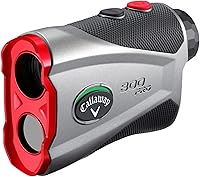
Callaway 300 Pro
The Callaway 300 Pro is the golf-first pick, thanks to an external slope on/off switch that's legal for tournament play. Flip slope off and the unit complies with the rules; flip it on for practice rounds and it accounts for elevation.
It measures the angle of incline or decline and calculates the slope-adjusted distance, so the number on screen already reflects the hill.
Pin Acquisition Technology locks onto the flag up to 300 yards away, and a pulse vibrates to confirm the lock. The 6x magnification and 5 to 1,000 yard range match the Nikon's reach, and accuracy is ±1 yard.
The Magnahold magnet holds it on the cart frame, and the hard case includes a carabiner and an elastic quick-close band. It measures in yards or meters.
At 8 ounces it's nearly double the Nikon's weight, and its 4 x 2.7 x 1.4 inch body is chunkier. The Bushnell Tour V7 Shift review is another golf option if you want to compare slope-switch designs.
REVASRI Hunting Laser Rangefinder
The REVASRI is the rechargeable all-rounder. A built-in Li-ion battery charges over USB-C, so you never hunt for a spare cell.
It carries seven modes, including golf distance compensation, speed measurement and height between two points. Mode memory reopens whatever you used last, which saves a trip through the menu every time you turn it on.
The 6.5x magnification and 24mm lens beat the Nikon on light gathering, and the 3.8mm exit pupil is larger too. Accuracy is ±1 yard, the same as the Nikon.
The angle range runs to ±90 degrees. Water resistance is IP54, lower than the Nikon's IPX4-equivalent rating, and the ABS body weighs 4.23 ounces.
It includes a pouch, lanyard, lens cloth and USB-C cable. The Blue Tees Series 3 Max+ review covers another rechargeable option if you want a golf-leaning comparison.
Verdict: is the Nikon PROSTAFF 1000i worth it?
Yes, the Nikon PROSTAFF 1000i is worth buying if you shoot on angled ground and want a light, simple unit. ID slope correction to ±89 degrees, TRU Target priority modes and a 1,000-yard range cover the core hunting job, and the 4.6-ounce body makes it easy to carry all day.
The 5-year warranty and the 17mm eye relief for glasses wearers round out a tool built for field use rather than a spec sheet.
Pick it for bow or gun hunting in hills and timber. Choose the Callaway 300 Pro if tournament golf is your priority, or the REVASRI if you'd rather charge over USB-C and want a bigger lens.
The Nikon remains the strongest all-round hunting pick of the three.
Range a known distance once it's set up to confirm it reads true. That one-minute check tells you more than any spec sheet.
Frequently asked questions
Is the Nikon PROSTAFF 1000i good for bow hunting?
Yes. ID incline/decline technology converts angled readings to true horizontal distance, which is the number that matters when shooting steeply up or down.
Nikon rates accuracy at ±1 yard to 100 yards and ±2 yards beyond, and the 17mm eye relief works for eyeglass wearers.
What does TRU Target do on the Nikon PROSTAFF 1000i?
TRU Target lets you switch between First Target and Distant Target Priority. First Target isolates a single object close to you, while Distant Target measures the farthest object in a group.
That matters in dense foliage or when branches and animals overlap.
How far will the Nikon PROSTAFF 1000i range?
Nikon rates the maximum range at 1,000 yards to reflective surfaces. Accuracy is ±1 yard up to 100 yards and ±2 yards beyond that.
Reach depends on target reflectivity and light, so expect shorter readings on dull objects like trees.
Is the Nikon PROSTAFF 1000i waterproof?
Nikon describes the housing as IPX4-equivalent water-resistant and calls it waterproof, so it handles rain and snow. It is not rated for submersion.
Dry it after wet use and keep the battery compartment sealed.
Does the Nikon PROSTAFF 1000i measure slope?
Yes. ID technology reads incline and decline angles up to ±89 degrees and displays the true horizontal distance.
That gives you the flat-ground equivalent for an uphill or downhill shot, which is what you want for drop compensation.
What battery does the Nikon PROSTAFF 1000i use?
It runs on a single lithium battery, which Nikon includes in the box. There is no USB charging, so carry a spare cell on long trips.
Nikon backs the rangefinder with a 5-year warranty.