7 Best Golf Rangefinders With GPS (November 2026)
The best golf rangefinders with GPS include the Blue Tees Captain Pro for laser and GPS in one, the Wearable4U Bushnell Phantom 3 Slope Golf GPS for touchscreen course maps, and the Garmin Approach G12 for a pocket-sized clip-on.
On this page (4 sections)
The best golf rangefinder with GPS for most players is the Blue Tees Captain Pro, because it combines a 1200-yard laser with front, center and back green distances in one body. If you want a small clip-on GPS, the Garmin Approach G12 is the pick, and the Wearable4U Bushnell Phantom 3 Slope suits anyone who prefers a big touchscreen on the cart.
A GPS rangefinder tells you how far you are from the green, while a laser tells you how far you are from the flag. The best golf rangefinder with gps does both, which is why the top pick here pairs a laser with course maps.
That combination removes the guesswork on approach shots and lets you plan a layup without doing math in your head.
This roundup covers seven models across three jobs: laser plus GPS in one unit, GPS-only units for green reads, and simple lasers for players who just want a pin number. Every score weighs specs and features against what you actually need on the course.
If you're still working out what these devices do, our guide to what is a golf rangefinder covers the basics before you spend.
Our picks at a glance
-
1

-
2
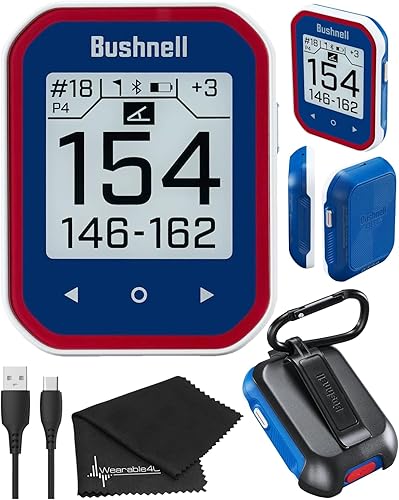 Best for touchscreen course maps
Wearable4U Bushnell Phantom 3 Slope Golf GPS
8.4/10 our score
See it on Amazon -
3

- 4
 Check it
MILESEEY G1 Touchscreen & GPS Rangefinder
Best for a big screen without a subscription - 5
 Best for a simple laser on a budgetCheck it
- 6
 Best for talking yardagesCheck it
- 7
 Best for reading the screen from a cartCheck it
The best golf rangefinders with GPS for your game
Blue Tees takes the top spot for players who want one device for everything. The other picks each solve a narrower need, from a tiny clip-on to a talking GPS you can hang on your hat.
Pick by how you play a hole, not by how many features a page lists.
Blue Tees Captain Pro: Best for laser and GPS in one
- 1200-yard laser with 7X magnification
- GPS front, center and back distances
- Slope, wind, elevation and temperature calibration
- OLED display and IP67 waterproof rating
A laser and GPS in one body, so you get a pin distance and a green picture without reaching for a second device. Club suggestions appear in the display.
Pros
- Laser and GPS in one unit
- Slope plus wind and elevation correction
- IP67 waterproof with a magnetic cart mount
Cons
- One of the heavier picks here
- Connected app features depend on your phone
The Captain Pro is for the player who wants a pin number and a green read without carrying two gadgets. Its laser reaches 1200 yards with 7X magnification and flag lock with vibration feedback, so you know when you've caught the pin.
At 8 ounces it sits in the middle of this group by weight, light enough to hang on the cart without dragging on the frame.
The GPS side gives front, center and back distances, which matters on a long approach where the flag sits near the front or back edge. True Distance technology lets you toggle slope, wind, elevation, temperature and humidity, and club suggestions appear in the display.
The connected GAME app adds round and club data across 42,000+ courses and a find-my-rangefinder locator for when it goes missing in the bag.
The OLED screen stays readable in bright sun or low light, and the magnetic strip grips a cart frame. IP67 waterproofing means rain won't end your round.
The trade-off is size and complexity: this is one of the heavier picks here, and the app features lean on your phone. Choose it for a complete picture of every shot.
Wearable4U Bushnell Phantom 3 Slope Golf GPS: Best for touchscreen course maps
- 38,000+ preloaded courses
- Touchscreen with intuitive UI
- GreenView with movable pin placement
- Battery rated for up to 18 hours
A GPS-only unit with a large touchscreen and a magnet mount, built for quick front, center and back reads. GreenView lets you move the pin for a more precise flag distance.
Pros
- Large 3.9 in touchscreen
- GreenView movable pin placement
- BITE magnetic mount for the cart
Cons
- No laser, so no exact pin distance
- Touchscreen adds size next to a laser model
The Phantom 3 Slope suits the player who likes tapping a screen instead of squinting through an eyepiece. Its 3.9-inch touchscreen is one of the largest displays in this group, and the interface handles course and hole recognition so you spend less time poking at menus.
Auto score prompts and auto course updates cut down the fiddling even more.
It's a GPS-only device, so it gives front, center and back distances rather than a laser shot at the flag. GreenView with movable pin placement lets you cycle through pin positions and pick one for a more precise read.
The BITE magnetic mount holds it on the cart, and the battery is rated for up to 18 hours, about four rounds. The bundle adds a belt clip and carabiner, so you can carry it on foot as well as on the cart.
Choose it if a big, clear screen matters more than an exact flag number. Skip it if you want a laser in the same device, or if you already carry a watch that shows the green.
Our roundup of the best golf rangefinder watch covers wrist options if that's your preference.
Garmin Approach G12: Best for a pocket-sized clip-on
- 42,000+ preloaded courses
- Front, back and middle green distances
- Green View with manual pin placements
- Up to 30 hours of battery in GPS mode
A thin GPS unit that clips to a pocket or bag and shows yardages at a glance. Big-numbers mode keeps the read large enough to see without squinting.
Pros
- Up to 30 hours of battery
- Built-in clip and lanyard loop
- IPX7 water resistance
Cons
- No laser rangefinder
- Monochrome display only
The Approach G12 is the pick for minimalists. It's thin enough to clip to a pocket or hang from a bag with the lanyard loop, and it shows yardages at a glance without a laser or a touchscreen to fuss over.
At about 1.8 inches square and half an inch thick, it nearly disappears in a pocket.
Garmin preloads more than 42,000 courses and adds wireless course updates when paired with a phone. Big-numbers mode enlarges the front, middle and back read, which helps if your eyes aren't what they were.
Green View shows the shape of the green with manual pin placements, and the battery runs up to 30 hours in GPS mode. Hazard and dogleg positions are on screen too, so you can plot a line off the tee without a laser.
It's IPX7 water-resistant, so rain is fine. The trade-off against the Captain Pro is simple: no laser, no slope, no club suggestions.
You get a small, light, long-lasting GPS. Pick it if you want a second device next to your laser, or if you'd rather not carry an expensive rangefinder in your pocket.
MILESEEY G1 Touchscreen & GPS Rangefinder: Best for a big screen without a subscription
- 2.13 in AMOLED touchscreen
- 43,000+ courses with no subscription
- 600-yard flag lock with vibration
- Ball to Pin mode for any two points
A laser with a full-color touchscreen and built-in course maps. Ball to Pin mode measures between two points, which helps plan carries over bunkers and water.
Pros
- Large color AMOLED touchscreen
- Free lifetime course updates
- SmartSlope with a tournament-legal off switch
Cons
- No magnet, so you need the separate magnetic case
- Heavier than the compact GPS units here
The MiLESEEY G1 is for the player who wants a modern screen and no subscription. Its 2.13-inch AMOLED touchscreen is a full-color display on a golf rangefinder, and you can tap, swipe and zoom without opening a phone app.
The red and green display stays readable as the light changes.
It has 43,000+ courses built in with free lifetime updates. The laser locks the pin from 600 yards in 0.1 seconds with ±0.5-yard accuracy and vibration confirmation.
SmartSlope adjusts for elevation, temperature and humidity, and a rotating external switch turns slope off for tournament play. Ball to Pin mode measures between any two points, so you can work out a carry over a bunker or water.
Rain and fog mode plus IP65 protection keep it running in bad weather, and the battery is rated for up to 24 hours.
The catch is mounting: there's no magnet, so you need the separate magnetic case if you want it on the cart. It's one of the heaviest units here.
Pick it for the screen and the no-fee course access.
Acer Gadget: Best for a simple laser on a budget
- 800-yard range with 6x magnification
- Anti-shake for steady readings
- Slope on and off
- USB-C rechargeable
A plain laser rangefinder with slope and flag lock. It has no GPS, so you aim at the pin for a number rather than reading a course map.
Pros
- Anti-shake helps steady the read
- USB-C rechargeable
- Slope can be switched off for tournaments
Cons
- No GPS distances or course maps
- Shorter 800-yard range than the top pick
The Acer Gadget is a straightforward laser for players who don't need course maps. Its 800-yard range with 6X magnification and ±0.5-yard accuracy covers most approach shots, and anti-shake technology helps steady the reading when your hands aren't rock solid.
The bright LCD keeps the number visible in daylight.
Slope compensation can be switched off for tournament rounds. Flag lock with vibration confirms you're on the pin.
It recharges over USB-C, so no coin cell to hunt for before a round. Six modes cover slope, vertical and horizontal distance, angle and speed, plus a scanning mode for sweeping across a target.
That last set leans toward hunters and archers as much as golfers.
Compared with the top pick, you give up GPS distances, front, center and back reads, and slope plus weather correction. You also get a shorter 800-yard range.
What you keep is a simple, rechargeable laser that does one job well. Pick it if you want a pin number and nothing else, or as a backup in the bag.
For a deeper look at handheld options without a laser, see the best handheld golf gps units.
GolfBuddy Voice 2S+: Best for talking yardages
- Talking GPS with voice guidance
- 40,000 preloaded courses
- Front, center and back distances
- Up to 18 hours in golf mode
A GPS unit that speaks your yardages so you can keep your eyes on the fairway. The small LCD also shows front, middle and back distances.
Pros
- Voice guidance with adjustable volume
- Clips to a hat or belt
- Automatic course and hole recognition
Cons
- No laser for an exact pin distance
- Small 1 in display
The Voice 2S+ is for the player who wants yardages spoken rather than shown. Press one button and it tells you the distance to the front, center and back of the green, so you can keep your eyes on the fairway and your hands on the grip.
It clips to a hat or belt and has a 1-inch LCD for a quick visual check. GolfBuddy preloads 40,000 courses with automatic course and hole recognition.
The battery is rated for up to 18 hours in golf mode, about three rounds. Audio volume adjusts from 0 to 5.
The screen also shows the shape of the green and your angle of approach, plus hole and par numbers, and a tap of the button tracks how far you hit the last shot.
The limits are real: no laser, so no exact pin number, and the 1-inch screen is the smallest here. Pick it if you play fast and want hands-free reads, or if a visual display is hard to see in sunlight.
It's a friendly first GPS for a new player.
Izzo Swami Max: Best for reading the screen from a cart
- Oversized 3.5 in color screen
- 38,000 global course maps
- Strong integrated magnet
- Up to 16 hours of battery
A handheld GPS with a big color screen that can sit on the cart frame. Front, center and back distances are easy to read from a seated position.
Pros
- Large 3.5 in color display
- Rotates between portrait and landscape
- Auto course recognition and hole advance
Cons
- GPS only, with no laser
- Shortest battery life in this group
The Swami Max is built around its screen. The 3.5-inch color display is one of the largest displays here, and it rotates between portrait and landscape so you can read it from the cart seat.
You can also set it to show only the center distance in a larger font.
Izzo preloads 38,000 global course maps with no subscription or update fees. A strong integrated magnet holds it on the cart frame, and auto course recognition and hole advance mean less tapping between shots.
It measures shot distance and keeps a digital scorecard. Front, center and back reads sit alongside layup and carry distances to hazards and doglegs.
The trade-off is battery life: up to 16 hours, the shortest in this group. It's also GPS only.
Pick it if reading the screen from a cart matters more than an exact flag number or a long battery. It suits a player who likes to see the green shape and hazard carries at a glance.
How these golf rangefinders with GPS compare
The top pick leads on features, but each unit wins on one thing: screen size, battery life, size in the pocket or course access. Use this table to match the device to how you actually play.
| Product | Best for | Range | Magnification | Mounting | Our score |
|---|---|---|---|---|---|
| Blue Tees Captain Pro | laser and GPS in one | 1200 yd | 7x | Magnetic cart mount | 8.7 |
| Wearable4U Bushnell Phantom 3 Slope Golf GPS | touchscreen course maps | BITE magnet mount | 8.4 | ||
| Garmin Approach G12 | a pocket-sized clip-on | Clip and lanyard loop | 8.3 | ||
| MILESEEY G1 Touchscreen & GPS Rangefinder | a big screen without a subscription | 1300 yd | 6x | 8.2 | |
| Acer Gadget | a simple laser on a budget | 800 yd | 6x | 7.9 | |
| GolfBuddy Voice 2S+ | talking yardages | Clip on hat or belt | 7.6 | ||
| Izzo Swami Max | reading the screen from a cart | Integrated magnet | 7.5 |
Our score weighs specs, features and how well each device fits what a golfer wants from a GPS rangefinder. The Captain Pro earns the top mark because it's one of the picks with a laser and GPS in one body, so it covers the pin number and the green read together.
Its 1200-yard laser is among the longest ranges in this group, behind the MiLESEEY G1 at 1300 yards and well ahead of the Acer Gadget at 800.
The Garmin Approach G12 scores well on battery and size, but its monochrome display and lack of a laser keep it behind the top pick. The Phantom 3 Slope has the best screen and the easiest cart mount among the GPS-only units.
The MiLESEEY G1 stands out for its color touchscreen and free course updates, though the missing magnet costs it a little.
The Acer Gadget, GolfBuddy Voice 2S+ and Izzo Swami Max sit lower because each does one job rather than several. That's not a knock: a plain laser or a talking GPS is exactly what some players want.
Pick the lowest-scoring model only if its single strength is the one you need most.
Laser versus GPS distances in practice
A laser reads the flag itself, so it's the number you want when the pin is tucked and the green is deep. A GPS reads your position against mapped course data, so it tells you how much room you have to the front, middle and back.
The two disagree most on long approaches and when the pin sits near an edge. That's why the combined units here earn their keep, and why a laser-only player might still want a small clip-on GPS for the green picture.
Players who only want a number to the flag can skip the maps and carry less.
What should you look for in a golf rangefinder with GPS?
Start with whether you want a laser, GPS or both. A laser gives an exact pin number, GPS gives the green picture and hazards, and a combined unit gives you both in one device.
Decide that first, then match the screen, battery and mounting to your round.
Laser plus GPS or GPS only?
A combined unit like the Captain Pro or the MiLESEEY G1 means one device for every shot. You shoot the flag for a number and glance at the screen for front, center and back.
GPS-only units are smaller and simpler, but you lose the exact pin read. Most players who play often and care about approach shots will get more from a combined model.
Casual players who mostly want a green read can save size and weight with a GPS-only unit. Check that a combined unit's slope mode has an off switch if you play competitions.
How big a screen do you want?
Screens range from the 1-inch LCD on the GolfBuddy Voice 2S+ to the 3.9-inch touchscreen on the Phantom 3 Slope. A big screen is easier to read from a cart seat and shows more of the green.
A small screen keeps the device light and pocket-sized. If you walk and carry, smaller wins.
If you ride, the Swami Max or Phantom 3 Slope makes the read easier without leaning in. The Garmin's monochrome display trades color for battery life and size.
What battery life do you need?
The Garmin Approach G12 runs up to 30 hours, the MiLESEEY G1 up to 24, the Phantom 3 Slope and Voice 2S+ up to 18, and the Swami Max up to 16. A single round takes about four to five hours, so 16 hours covers three rounds.
Charge after every couple of rounds and battery won't be an issue. If you play multi-day trips without easy charging, the Garmin is the safer choice.
The Captain Pro recharges over USB-C, which is handy if you already carry that cable for your phone.
Do you need slope correction?
Slope adjusts the yardage for elevation, and some models also factor in wind, temperature and humidity. The Captain Pro toggles all of those, and the MiLESEEY G1 and Acer Gadget let you switch slope off for tournaments.
If you play in competitions, check that the model has an off switch or a tournament-legal mode. If you play casual rounds, slope correction helps you club up on uphill shots and down on downhill ones.
A model without slope leaves that math to you.
How much does mounting matter?
A magnetic cart mount keeps the device in reach and off the ground. The Captain Pro, Phantom 3 Slope and Swami Max all mount on the cart.
The Garmin clips to a pocket or bag, and the Voice 2S+ clips to a hat or belt. The MiLESEEY G1 has no magnet, so you need its separate magnetic case.
Think about where you'll keep the device during a round before you buy. If you walk most rounds, a clip or hat mount beats a cart magnet you'll never use.
Which golf rangefinder with GPS is right for you?
Pick the Blue Tees Captain Pro if you want one device that gives both a pin number and a green read. Choose the Garmin Approach G12 for a tiny, long-lasting clip-on GPS, or the Wearable4U Bushnell Phantom 3 Slope if a big touchscreen on the cart is what you want.
If you want a color touchscreen without a subscription, the MiLESEEY G1 is the pick. The Acer Gadget suits a player who only needs a laser, the GolfBuddy Voice 2S+ is for hands-free talking yardages, and the Izzo Swami Max is best when you read the screen from a cart seat.
The best golf rangefinder with gps for you is the one whose single strength matches how you play. For watch-style options, our Garmin vs Bushnell golf GPS watches comparison covers the wrist category next.
Our top 3 picks at a glance
-
1
-
2
Best for touchscreen course maps
Wearable4U Bushnell Phantom 3 Slope Golf GPS
8.4/10 our score
See it on Amazon -
3
Frequently asked questions
Is a GPS rangefinder allowed in tournaments?
GPS distance devices are usually allowed when the local rule permits distance-measuring devices. Laser models with slope need the slope mode switched off for play.
Check your committee's local rule before your round.
How accurate is a GPS rangefinder compared with a laser?
A laser measures straight to the flag, so it gives the exact pin number. A GPS works from mapped course data, which is close but not pinpoint.
Many players use GPS for the green picture and laser for the flag.
Do GPS rangefinders need a subscription?
Not always. The MiLESEEY G1 includes free lifetime course updates with no subscription.
The Izzo Swami Max also has no subscription or map update fees.
Check each model before buying.
How long does a golf GPS battery last?
It varies by model. The Garmin Approach G12 is rated for up to 30 hours in GPS mode, the Wearable4U Bushnell Phantom 3 Slope and GolfBuddy Voice 2S+ for up to 18 hours, and the Izzo Swami Max for up to 16 hours.
Can I use a laser rangefinder without GPS on the course?
Yes. A laser like the Acer Gadget gives you a pin number without any course maps.
You lose front, center and back reads and hazard distances, so you aim at the flag for every shot.


